The Two-Minute Rule: Do It Now, or Write It Down
Two minute rule: finish anything under two minutes now, or write it down. Here is the decision, a worked list and the three places it fails.
By All-in-One Task Tracker by Cosmo Suite · Editorial policy
Published · 9 min read
Use the two-minute rule as a decision, not a habit: if a task takes two minutes or less and you need to do it at all, do it now. If it takes longer, write it down with a date so it leaves your head and comes back on the day it matters.
The second half is where most people lose it. Most posts stop at "do it now" and leave the writing-down part vague, and that is where small tasks turn into a list nobody reads again.
Two different rules share this name. One clears small tasks before they pile up; the other starts a habit you keep postponing. Articles that rank for the term usually mix them, so this post keeps the two apart, runs a 14-row list through the decision, and names the places where the test fails.
If your quick tasks and your real work already live in different places, the All-in-One Task Tracker (by Cosmo Suite: one Excel and Google Sheets file, 11 tabs, $9 once) keeps both kinds of row in one file you own.
The Two-Minute Rule at a Glance
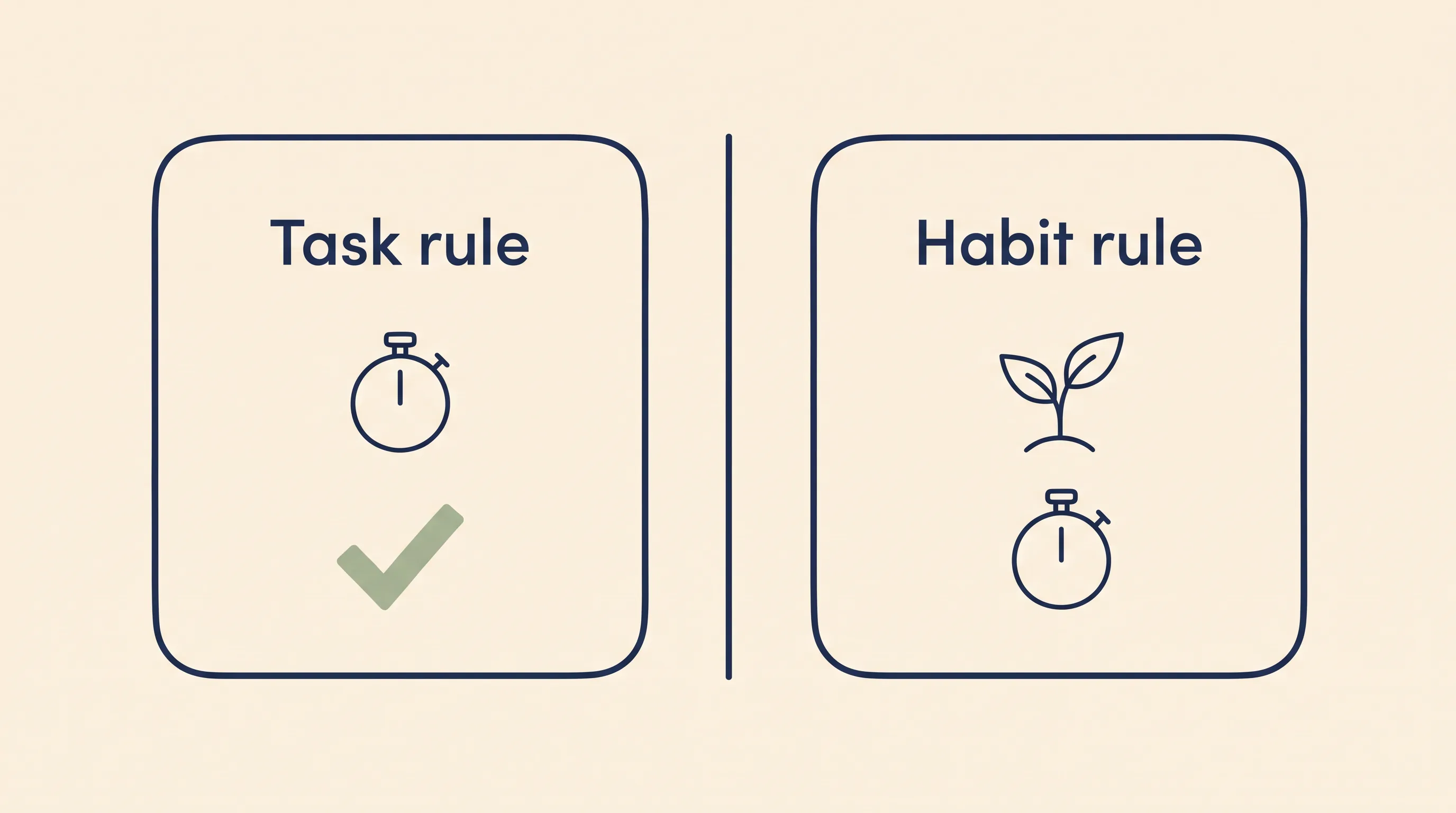
The two-minute rule is a decision rule for small tasks: if something takes two minutes or less and you need to do it at all, do it immediately instead of adding it to a list. A second version, popularised for habits, shrinks the first step of a new routine until it takes two minutes to start.
| Version | The rule | Question it answers | Best for |
|---|---|---|---|
| Task rule (David Allen) | If it takes under two minutes, do it now | Should this go on my list at all? | Clearing small errands before they pile up |
| Task rule, second half | If it takes longer, start the first two minutes | How do I begin a task I keep avoiding? | Large tasks you cannot finish in one sitting |
| Habit rule (James Clear) | Shrink the habit until starting takes two minutes | How do I begin when I do not want to? | Starting a routine you keep postponing |
| Task rule, inverted | If it takes longer, write it down with a date | Where does the rest go? | Keeping a list you can trust |
David Allen's version appears in Getting Things Done, and the GTD team states it plainly: "Anything you can do in less than two minutes, if you need to do it at all then do it right then." James Clear's version, in an excerpt from Atomic Habits, is a different rule with the same name: "When you start a new habit, it should take less than two minutes to do." Clear credits Allen separately in a footnote on that page.
The task version is a filter on what enters your list. The habit version is a limit on how much you ask of yourself at the start. Neither tells you what to do first, which is a separate question answered by a daily list shape such as 1-3-5.
A Tuesday List, Worked Through
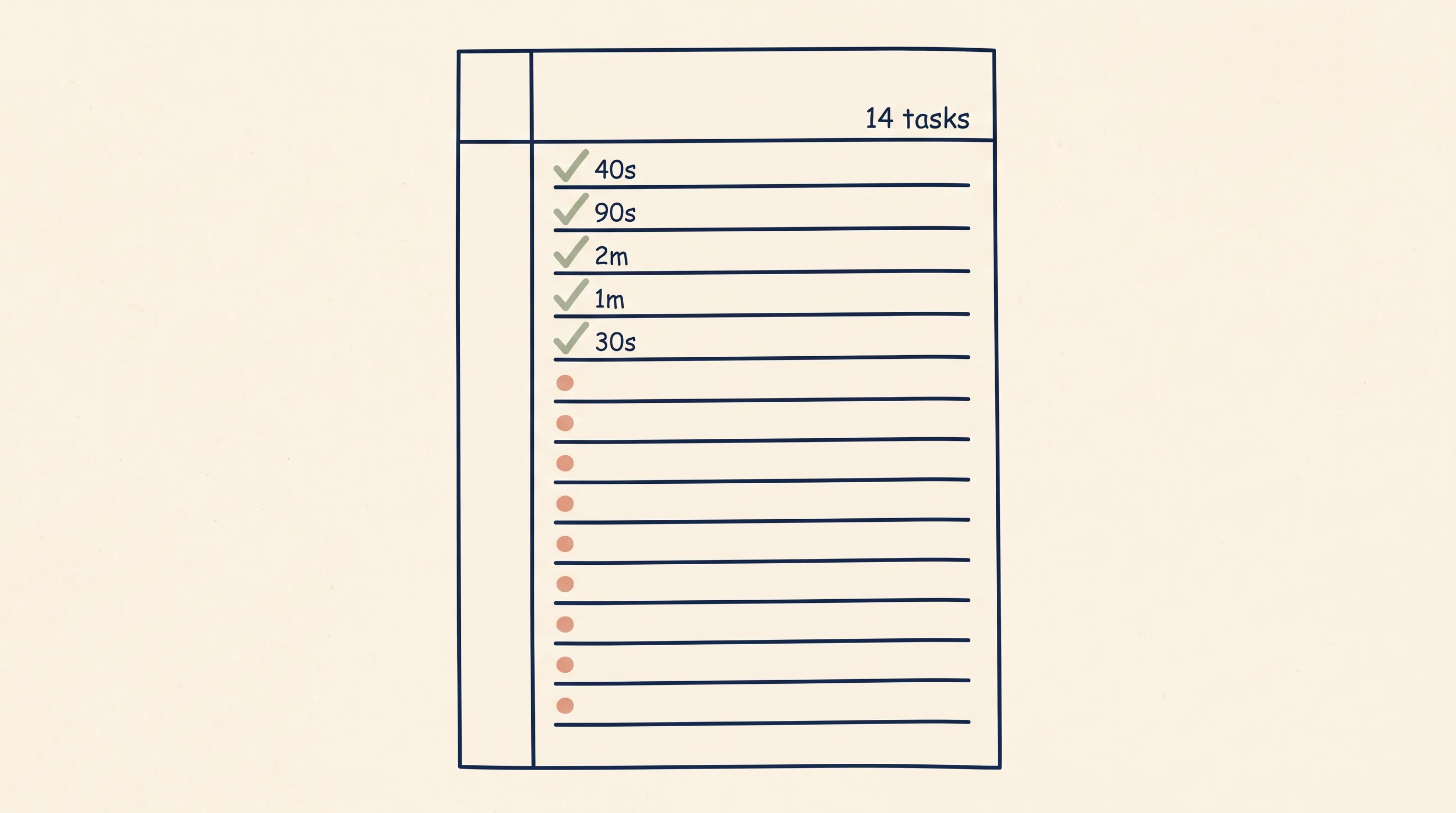
This fictional Tuesday has 14 open tasks. Five of them pass the two-minute test, which leaves nine, and the example does not describe a real person or promise a particular result.
| Task | Clock time | Verdict |
|---|---|---|
| Reply "yes" to the meeting invite | 40 seconds | Do now |
| Move the bin out | 90 seconds | Do now |
| Send the signed form as a photo | 2 minutes | Do now |
| Add the dentist number to contacts | 1 minute | Do now |
| Delete the duplicate calendar entry | 30 seconds | Do now |
| Renew the domain | 6 minutes | Write down, date Friday |
| Draft the status note | 25 minutes | Write down, date today |
| Book the eye test | 4 minutes | Write down, date this week |
| Sort the receipts folder | 12 minutes | Write down, no date yet |
| Read the policy update | 9 minutes | Write down, date Monday |
| Fix the printer | 3 minutes | Write down, date today |
| Update the address in two accounts | 8 minutes | Write down, this week |
| Review the draft | 20 minutes | Write down, today |
| Reply to the long email | 11 minutes | Write down, today |
The five quick rows take about six minutes in total, and doing them now removes five rows and five separate decisions from the rest of the week. The six minutes matter less than the five times you would otherwise have re-read the same row and skipped it again on Wednesday.
The printer row is the interesting one, because it looks like a two-minute task and is really three minutes once the driver download is counted. Under the strict test it goes on the list. Under the loose test, where "about two minutes" is close enough, it gets done badly and leaves the printer half-fixed, which is worse than leaving the row alone.
The list after the five quick rows has nine tasks, and four of them carry today's date. Four tasks is a day a person can finish; 14 is arithmetic nobody can clear.
Step 1: Start the Clock When the Tool Is Open
Time the task from the moment the tool is open, not from the moment you decide to do it, because a two-minute task that needs a password reset, a phone unlock and a page load is not a two-minute task at all.
"Send the signed form as a photo" is under two minutes when the form is on the desk and the camera is already open. It is fifteen minutes when the form sits in an email you have to find on a laptop that wants to install an update first, and that gap is the part most write-ups leave out.
Test it this way: name the tool, then count. If the task needs a tool you cannot open in one step, either fix the access first or write the task down as the access step, because "find the form" and "send the form" are two rows and only the second one is quick.
The same logic applies outside the house. "Post the letter" takes ninety seconds at the box and twenty minutes of walking, so the rule is about the task and not the trip that surrounds it.
Step 2: Write It Down With a Date
A written-down task needs three things to survive the week: the action, a date, and a next step small enough to start. Miss one and the row becomes a note you skim past every morning.
A task action is a verb and an object. "Domain" is a note, while "renew the domain before Friday" is a task. A due date is a real date and not "soon", because the whole point of writing it down is that it comes back on a day you chose. The next step is the part most lists skip, since "renew the domain" hides the fact that you first need to find the login.
If the next step is unclear, write that down instead. "Find the domain login" is a two-minute task, and doing it now may turn the bigger row into a five-minute one, which is the rule working twice: once to clear the small step and once to make the big one smaller.
Keep the date in its own column rather than inside the sentence. A date written into the task text disappears when you sort the list, while a date in its own column survives every filter, and that is the reason a task list template puts due date and status in columns rather than in the task name.
Step 3: Delete It, or Move It Out of Today
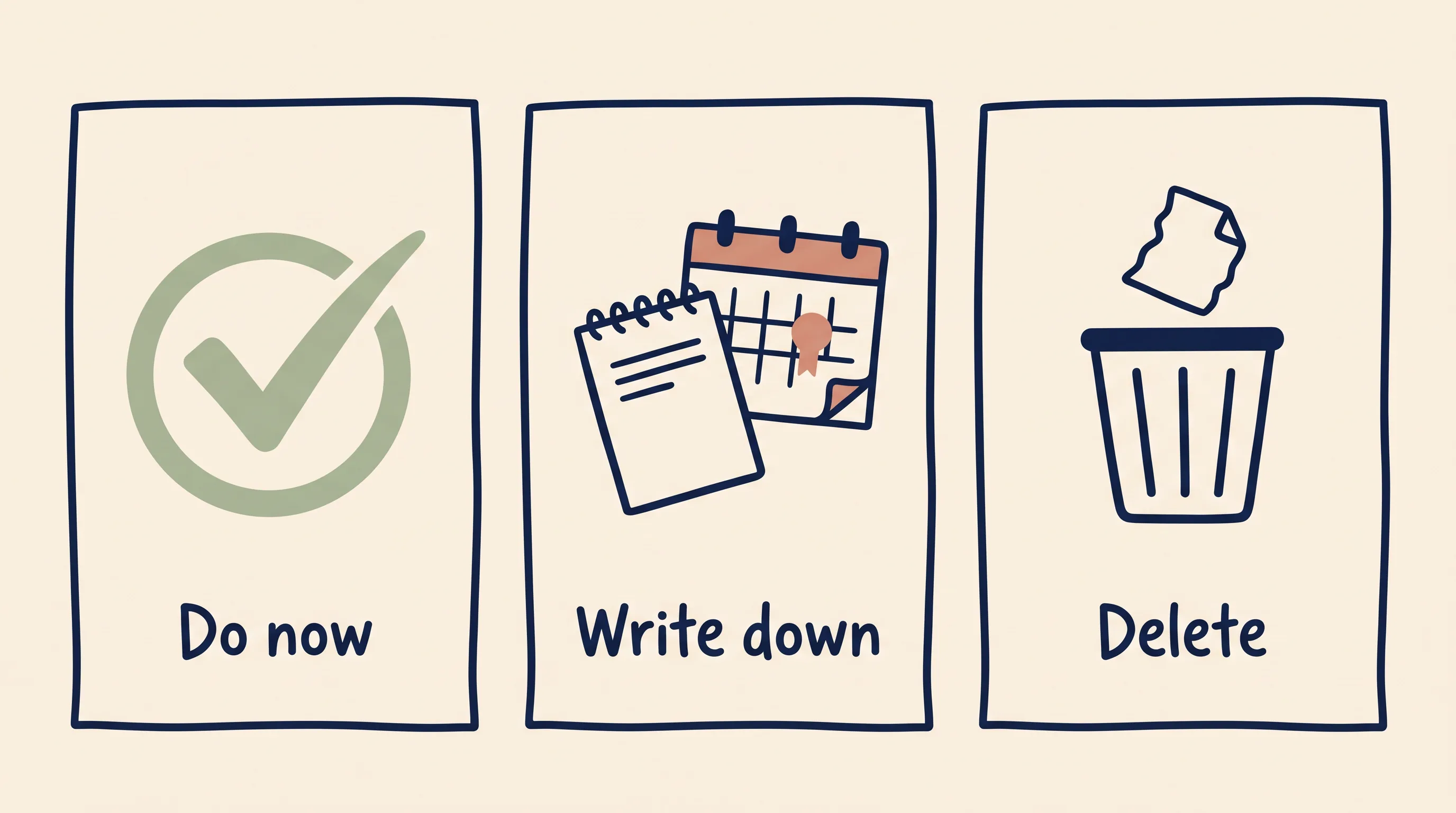
The usual advice gives you two options, do it now or write it down. A third one keeps a list from growing without limit.
Ask whether you would still do the task if nobody asked. If the answer is no, delete the row, because the duplicate calendar entry, the old version of a document and the task from a cancelled meeting all pass the two-minute test and still should not be done. If the answer is yes but not this week, move it out of the current view and give it a date or a folder, then stop looking at it until that date arrives.
A spreadsheet does this better than paper. A filter hides the rows you deferred, so today's list shows only what today holds. Lists that show everything at once are the most common reason people stop trusting lists.
What the Two-Minute Test Cannot Fix
The rule is a filter on small tasks, not a planner, and four things sit outside it no matter how carefully you apply it.
It does not size a day. Doing five quick tasks can fill the morning and leave the report untouched, so put the large block in the calendar first and run the rule around it rather than through it.
It does not rank. Two tasks of one minute each can have wildly different consequences, and the rule says do both now while saying nothing about which matters. That choice needs a due date, a dependency or an explicit priority, not a stopwatch.
It does not replace a recurring row. A task you do every week is not a two-minute task even when each run is quick, because the remembering is the cost, and a one-off list cannot hold that for you.
It does not fix a tool that is always shut. If most of your two-minute tasks are blocked by logins, the problem is access and not discipline, so save the passwords and keep the form in one folder. Randolph-Macon College's study tips add a use the usual summary leaves out: when something takes longer than two minutes, start on the first two minutes of it and focus only on that. The same page notes that momentum has to be bigger than the resistance to the task.
The University of Wisconsin's time management guide credits the rule to Allen and adds the reason it works: handling small items immediately stops them from accumulating into something that feels overwhelming. The University of Oregon's career services blog makes the same point in one line, that doing small tasks right away builds a sense of momentum.
Where the All-in-One Task Tracker Fits
The rule needs two things from a list: quick rows you can clear in one pass, and dated rows you can trust to come back on the right day. The All-in-One Task Tracker for Excel and Google Sheets is built for both in one file.
It has 11 tabs in four sections. Setup holds the starting point, and the three dashboard tabs are the All-in-One Dashboard, the Monthly Calendar and the Weekly Calendar. Four task tracking tabs hold Variable Tasks, Recurring Tasks with automation from weekly to yearly, Task Schedule and a Task Filter with more than 15 options. Three prioritization tabs hold the Decision Matrix (Do, Decide, Delegate, Delete), the Kanban Board and the Gantt Chart. It tracks up to 10,000 tasks and costs $9 once.
The two-minute rule maps onto that structure without extra work. Quick tasks go in as variable tasks and get cleared in one pass, tasks you write down get a due date and appear in the weekly calendar, and recurring work gets a recurring row instead of a new one each week. The filter hides what you deferred, so today's view holds only today.
The file does not set a timer and does not remind you. If you need push notifications or automatic calendar sync, an app is the better pick and this tracker does not claim either. It is for someone who wants the list, the dates and the views in one file they own.
Sources and Method
The Cosmo Suite team publishes this guide. Methodology: the Tuesday list is a fictional example, and its 14 rows are grouped by the clock time each one takes rather than by customer data. We opened the three university pages and the two method pages and checked them on 20 November 2026. The Clear page carries no publication date, so it is cited as an undated page with its check date.
Learn about us and read the editorial policy. Contact support@ultimatetasktracker.site to report a correction.
Frequently asked questions
What is the two-minute rule in task management?
It is a decision rule: if a task takes two minutes or less and you need to do it at all, do it now instead of adding it to a list. Anything longer gets written down with a date so it does not stay in your head.
How do I procrastinate less with this rule?
Shrink the start, not the task. Pick the smallest action that opens the work, such as opening the file or writing one sentence, and give it two minutes. Starting is the part the rule is designed to lower.
Who created the two-minute rule?
David Allen described the task version in Getting Things Done: if a task takes less than two minutes, do it now. James Clear later described a habit version in Atomic Habits: shrink a new habit to a version that takes under two minutes to start.
Is the two-minute rule the same as the five-minute rule?
No. The five-minute rule usually means starting a task for five minutes and then deciding whether to continue. The two-minute rule is about finishing small tasks immediately, or about shrinking the start of a habit. The numbers set different limits.
What if the task really takes three minutes?
Then it is not a two-minute task and the test says write it down. A task that always runs over is usually blocked by a tool or a login, not by the work. Fix the access first, then re-test it.
Does the two-minute rule work in a spreadsheet list?
Yes, if the list has a due date and a status column. Do the quick items now, write the rest as rows with a date, and delete the rows you will never do. The rule only holds when the written-down version can be found again.
Sources
- Randolph-Macon College, Higgins Academic Center: Study Strategies, tips to increase productivity
- University of Oregon, Mohr Career Services: Procrastination, the Struggle is Real
- University of Wisconsin, Local Government Education: Time Management
- Getting Things Done: The Two Minute Rule
- James Clear: How to Stop Procrastinating